- (781) 521 - 6395
- info@jclconstructioninc.com
- jclconstruction.hours@gmail.com
- Mon - Fri: 7:00 - 17:00Saturdays by appointment
Few design elements change the character of a room — or a commercial space — as immediately and dramatically as a well-executed accent wall. And among the many accent wall options available to homeowners and business owners in Cambridge and Boston, decorative wood panel millwork has emerged as one of the most sophisticated and enduring choices in recent years.
From fluted wood slat panels on a commercial reception desk to shiplap feature walls in a residential living room, custom wood millwork brings warmth, texture, and architectural depth to spaces that paint and tile alone cannot achieve. At JCL Construction, Inc., we design and install custom millwork and decorative wood panel accent walls throughout Cambridge, Boston, and the Greater Boston area — in both residential renovations and commercial build-outs. Here is what homeowners and business owners should know about this design element and what it takes to execute it correctly.
The appeal of wood panel millwork is rooted in contrast. Boston and Cambridge interiors — whether in a renovated brownstone, a modern condo, or a professional office — tend to feature neutral walls, light flooring, and clean architectural lines. Against that backdrop, a wood panel accent wall introduces organic texture, warm tone, and visual depth that makes an entire space feel more considered and complete.
Unlike paint, which changes the color of a surface, or tile, which changes its material, wood panel millwork changes the architectural geometry of a wall — adding dimensionality through shadow lines, relief, and the natural variation of wood grain. The result is a surface that reads differently at different times of day as light moves across it, and that photographs exceptionally well in an era when visual presentation matters for both residential real estate and commercial brand identity.
The other reason wood panel millwork has grown in popularity across Greater Boston is its versatility. The same design language — vertical slats, horizontal boards, geometric panels, or applied molding grids — works across a wide range of contexts: a residential primary bedroom feature wall, a living room flanking a fireplace, a commercial reception desk, a restaurant host stand, or a retail storefront. The material and profile change to suit the context, but the underlying design principle — adding architectural depth to an otherwise flat surface — remains consistent.
Fluted and Reeded Wood Slat Panels
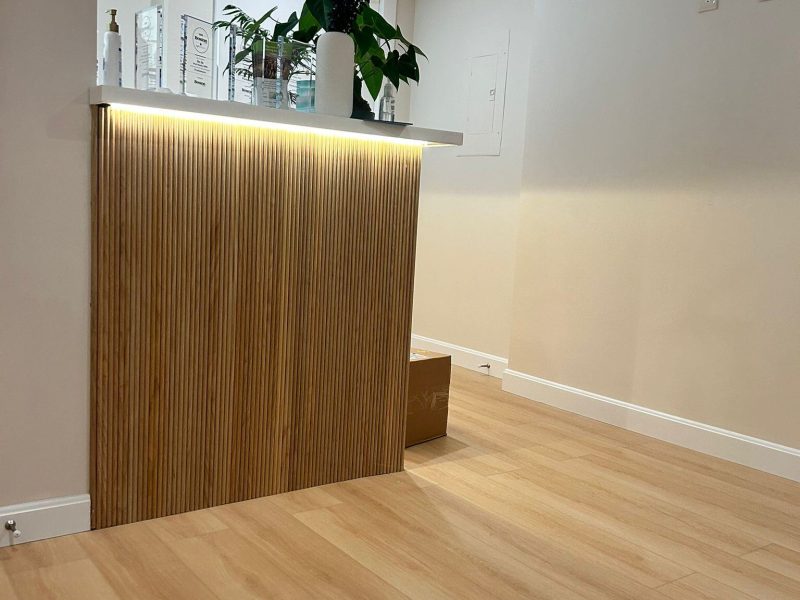
Fluted wood slat panels — vertical strips of wood with a rounded or chamfered profile, installed in a tight repeating pattern — are one of the most requested millwork elements in Greater Boston commercial and residential renovations right now. The dense vertical rhythm of the slats creates a rich, textural surface that reads as both contemporary and warm, and the shadow lines between each slat shift throughout the day as light angles change.
Fluted slat panels work particularly well on reception desk fronts, island bases, fireplace surrounds, and bedroom headwall features. When integrated with LED strip lighting — mounted beneath a floating shelf or countertop above the panel — the warm uplight emphasizes the texture of each slat and creates an ambient glow that transforms the space after dark.
Shiplap and Horizontal Board Walls
Horizontal shiplap — overlapping boards installed in a continuous horizontal pattern — is one of the most versatile and widely applicable wood panel options for residential spaces in Cambridge and Boston. It adds texture and warmth to living rooms, bedrooms, entryways, and mudrooms without the visual weight of vertical paneling, and it works equally well painted in a bold color or left in a natural wood finish.
In older Massachusetts homes where walls may have minor irregularities from decades of settling, shiplap’s horizontal lines are actually more forgiving than perfectly vertical slat patterns, which can reveal wall imperfections more clearly.
Wainscoting and Board-and-Batten
Wainscoting — panel millwork applied to the lower portion of a wall, typically topped with a chair rail — is one of the most historically appropriate accent wall treatments for the older homes of Cambridge and Boston, where Victorian and colonial architecture calls for this kind of traditional detail. Modern interpretations of wainscoting and board-and-batten use simplified profiles that feel at home in both traditional and contemporary interiors.
Board-and-batten — vertical boards with narrow strips covering the seams — works particularly well in entryways, hallways, and mudrooms, where it adds architectural character to what are often the most underdesigned spaces in a home.
Geometric Panel Grids and Applied Molding
For a more formal, architectural look — well suited to dining rooms, home offices, and upscale commercial interiors — applied molding grids create a paneled wall effect that references traditional New England interior architecture without replicating it exactly. The grid of flat or ogee-profiled molding applied to a painted wall creates depth and shadow at a fraction of the cost of full raised-panel millwork, and it can be painted in the same color as the wall for a subtle tonal effect or in a contrasting color for a bolder statement.
Acoustic Wood Slat Panels
In commercial applications — particularly offices, waiting rooms, and meeting spaces — acoustic wood slat panels combine the visual impact of decorative millwork with genuine acoustic performance. The slats are backed with an acoustic felt layer that absorbs sound, reducing echo and reverberation in hard-surfaced commercial spaces. For Cambridge and Boston businesses renovating open-plan offices or client-facing reception areas, acoustic slat panels address both design and functional performance in a single installation.
One of the most impactful decisions in a wood panel millwork installation is whether to integrate LED strip lighting into the assembly. When done well, integrated LED lighting transforms a decorative wood panel from a daytime design feature into an all-day architectural element that changes character as natural light fades.
The most common integration approach is recessed LED strip lighting mounted in a channel behind or beneath a floating shelf, countertop, or cap above the panel. The LED strip throws warm light downward across the face of the panel, emphasizing the texture and shadow lines of each slat or board and creating a soft ambient glow at the base of the assembly.
Key decisions in LED integration include:
The choice of wood species and finish profile determines how a decorative panel reads in its finished context — and it is one of the most important decisions in the design process.
White oak is the most popular species for contemporary wood panel millwork in Greater Boston right now. Its tight, straight grain, warm honey tone, and availability in clear grades make it ideal for fluted slat panels and feature walls where the natural character of the wood is meant to be visible. White oak takes both clear finish and stain well and ages gracefully.
Poplar is the standard choice for painted millwork — wainscoting, board-and-batten, applied molding grids, and any panel that will be finished with paint rather than a clear or stained finish. It machines cleanly, takes paint excellently, and is more cost-effective than hardwoods for applications where the grain will not be visible.
MDF (medium-density fiberboard) is widely used for painted panel millwork in both residential and commercial applications. It offers a perfectly smooth, grain-free surface that paints flawlessly and machines to clean, precise profiles — advantages that make it the preferred material for formal applied molding work and geometric panel grids where crisp edges and uniformity matter more than natural wood character.
Pre-finished acoustic slat panels are available from several manufacturers in a range of wood veneer species and profiles, and they offer the advantage of consistent factory finishing combined with the acoustic performance of a felt backer. For commercial installations where schedule and finish consistency are priorities, pre-finished panels reduce installation time compared to site-finished millwork.
Decorative wood panel millwork is one of those renovation elements where the gap between professional and amateur results is immediately visible — and where shortcuts in installation reveal themselves quickly over time.
Layout and planning — before the first panel is cut, the installation requires careful layout to ensure the pattern is centered on the wall, accounts for electrical boxes and switches, and handles the transitions at corners, door casings, and floor and ceiling lines correctly. An off-center slat pattern or a poorly handled corner transition undermines the entire installation.
Scribing and fitting — in older Cambridge and Boston homes and buildings, walls are rarely perfectly plumb, corners are rarely perfectly square, and floors are rarely perfectly level. Professional millwork installation involves scribing each panel and trim piece to fit the actual conditions of the space rather than assuming the geometry is ideal.
Fastening and adhesion — wood panel millwork must be fastened in a way that is both structurally secure and visually clean. Face-fastened panels with visible nail holes filled and painted are acceptable for some applications, but higher-quality installations use concealed fastening systems — blind-nailed through the tongue, construction adhesive, or clip systems — that leave the panel face completely uninterrupted.
Finishing and caulking — the quality of the paint or clear finish application, and the precision of the caulk lines at all transitions, determines whether the final result looks custom or kit-built. All gaps at corners, ceiling lines, and floor transitions should be filled and finished before final paint or clear coat is applied.
Residential applications:
Commercial applications:
A well-executed wood panel accent wall or custom millwork installation is one of the highest-impact design moves available in a renovation budget — it changes how a space feels, photographs, and presents to every person who enters it. At JCL Construction, Inc., our carpentry team designs and installs custom millwork throughout Cambridge, Boston, and the Greater Boston area with the precision and finish quality these elements demand.
Contact us today for a free estimate on your custom millwork project.
📞 (781) 521-6395
📧 info@jclconstructioninc.com

From remodeling and new construction to painting and flooring, we deliver quality workmanship you can trust. Contact our team today for a free estimate and professional guidance for your next project.
Trust JCL Construction, Inc. to make your construction projects a reality. Contact us today and let us be your trusted partner on the road to transforming your space!